
Meaning and Misdirection in the Age of AI
Between Algorithm and Intuition

The audio version of this article has been slightly modified for a better listening experience.
Dark clouds are gathering over the minds of younger generations. The rapid development of artificial intelligence, automation, and robotics is bringing profound change – above all, the threat of massive job losses, declining wages, and a growing sense of personal irrelevance. Emotions like fear, helplessness, and hopelessness are spreading – sometimes more intensely, sometimes more subtly – but always present in the consciousness and subconsciousness of many people.
The dominant societal narratives do little to alleviate these fears. Some now speak of a “useless part of the population” that must somehow be “managed” – through virtual worlds or widespread access to drugs and intoxicating substances. Others propose vague, underdeveloped solutions like unconditional basic income without reflecting on their deeper consequences.
At the root of this unease lies a technocratic and reductionist worldview – one that suggests we’ve reached the end of meaningful knowledge. What cannot be measured or tested experimentally is often dismissed as irrelevant, as though nothing of importance lies beyond our current horizon of understanding. This is not only presumptuous; it ignores history itself. Technological upheavals have repeatedly triggered paradigm shifts – and the transformation brought by AI is likely to do the same in the long run. Not necessarily through the technology itself, but through the profound questions it forces us to confront.
As AI begins to uncover and statistically analyze phenomena we have so far failed to explain, it could provide a new foundation for revisiting long-ignored fields of research – such as consciousness. That is, assuming AI moderation doesn’t cement ideological biases that suppress independent analysis. At the same time, AI raises a very real and urgent question: What is our purpose as human beings? Taken together, these forces may trigger not just an opportunity but an almost inevitable transformation – driven not by machines, but by the pressure of new insights they unleash.
This does not mean the risks of AI are imaginary. On the contrary: the threat of technological dominance, or even civilizational collapse, is very real and must be addressed with serious responsibility. But fear alone is not a path forward – certainly not toward a meaningful future.
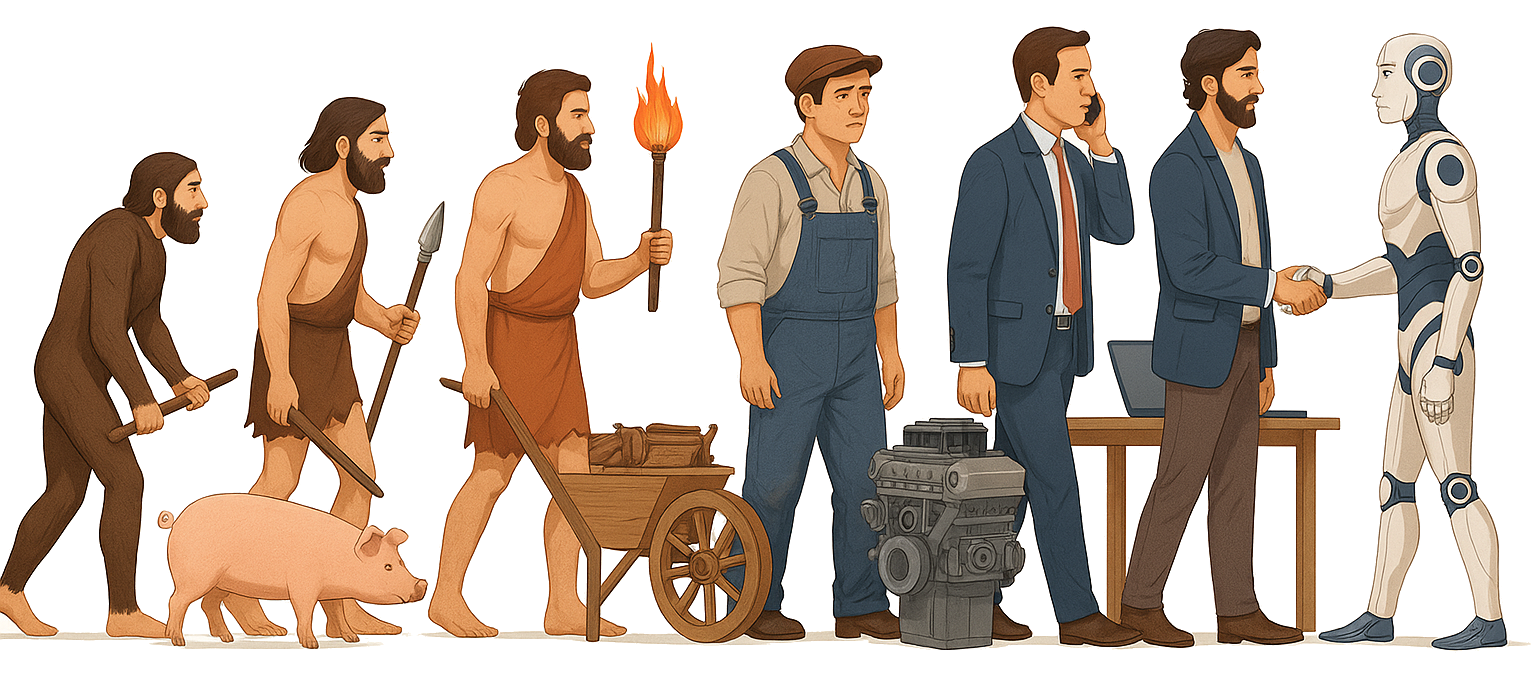
A Look Back: How Technology Has Shaped Our Economic Self-Image
Technology – understood as tools, knowledge, and applied experience – has always profoundly influenced how we live, how societies function, and how we understand ourselves. The shift from hunter-gatherers to settled farming communities was a major technological milestone: cultivating crops and domesticating animals reduced risk, created time resources, and allowed for the growth of larger communities.
Later, humans began to harness animal muscle power – using oxen to pull plows or carts, for example. But the truly radical transformation came with the Industrial Revolution. Physical labor was no longer performed by animals but by machines. Energy was converted into motion – through engines, the artificial “muscle,” in various forms.
This development was initially met with widespread fear. Many people feared the loss of their livelihoods, poverty, and societal decline. Jobs based on human muscle power came under immediate existential threat. In some areas, this fear even led to attacks on factories. Over time, however, societies adapted: new jobs and industries emerged, and social reforms followed – from labor protections to the rise of welfare systems. It became clear that industrial transformation, while risky and painful for many, also opened up new possibilities.
From Muscle to Motor, from Thinking to AI – and Beyond
Today, we stand at another threshold. AI, robotics, and automation are not only replacing physical labor but increasingly analytical and cognitive tasks as well. What was once the privilege of highly educated humans – logical thinking, structured planning, complex problem-solving – is now being taken over by machines. After conquering the realm of muscle, the machine now threatens to replace the mind. And many people are left asking: What’s left for us?
The magnitude of this shift is difficult to overstate. It’s no longer about individual professions but about a sweeping reorganization of entire industries. In many areas, it is not a question of if, but when. On top of that, the following risks of AI must be taken seriously:
- Concentration of power and wealth in the hands of a few
- Mass unemployment and social instability
- Discrimination and distortion through algorithmic bias
- Loss of privacy and pervasive surveillance
- Potentially uncontrollable autonomous systems
But fear will not help us. AI will be developed – by someone, somewhere. The real question is: Who will shape this transformation, and how?
Lessons from the Past – and New Opportunities
Just as in earlier eras, new professions will emerge – focused on developing, operating, and overseeing AI and robotic systems. But unlike previous industrial transitions, even these tasks are likely to be increasingly automated.
As long as machines lack their own fully integrated sensors, actuators, a dense and dynamic model of the world, and real-time access to all data, there will still be areas where human contextual judgment remains superior. In the interim, many new jobs will require integrated, cross-domain thinking, while repetitive tasks – both physical and cognitive – will increasingly be delegated to machines.
Still, this too is only a matter of time. Eventually, machines may surpass individual human capabilities in terms of overview, data access, and model precision. Then one final question remains: Should machines or humans make the ultimate decisions?
The answer must be: humans. But to do so meaningfully, people must be well educated, informed, and capable of sound judgment. Societies that foster these qualities will likely thrive, while others may fall behind on the long term.
Moreover, machines will inevitably fail in certain situations – particularly when it comes to identifying or correcting their own errors. A core level of human competence must be maintained, even if it appears inefficient in the short term.
Another major challenge is the “black box” problem: AI systems produce results whose internal logic is often opaque. But where exactly is the flaw – in the data, the algorithms, or hidden bias? New professions will emerge to answer precisely these questions – focused on analysis, oversight, and ethical AI use.
Human and Machine as Partners, Not Rivals
A healthy future will not be built on exclusion but on empowering people. AI can complement our abilities – and if deployed wisely, it can dramatically enhance our productivity and potential. This could ease the transition into the AI age and ensure that humanity remains at the center of its own evolution.
But what should we do with the wealth and free time AI could make possible?
Distributing money without responsibility or accountability might seem convenient in the short term, but it is risky in the long run. Historically, such approaches have rarely proven sustainable. While a so-called unconditional basic income may help individuals, at scale – and especially in its pure form – it risks fostering dependency, loss of motivation, and cultural erosion. Support during transitional phases is necessary; alongside this, a moderate basic income may also be sensible—but always with the aim of enabling people to return to meaningful activity and social participation. At the same time, there is a need for solutions that allow people to share in the new wealth emerging through AI.
This brings questions of control and ownership of AI into sharper focus. At the same time, there is the possibility of empowering individuals – alongside small teams – through increasingly powerful AI, software, and robotics to independently achieve outcomes that were previously reserved for start-ups or larger organizations. Unprecedented opportunities in research, innovation, and education become conceivable. Art, culture, and design – fields that are currently often undercompensated – could gain new significance in a more prosperous society, giving rise to many new professions.
As more basic needs are met, people naturally aim to climb Maslow’s hierarchy – from security to belonging, esteem, and self-actualization. This creates demand for new forms of education and purpose-driven careers.
The Human Edge: Emotions and Intuition
Another key perspective is this: What can humans do that machines cannot?
The answer lies in emotions, intuition (see “Rethinking Human Intelligence: Beyond Information Processing“) – and to some extent, genuine creativity. Machines don’t feel. What may appear “creative” in AI is often just an intelligent recombination of known elements. True novelty – the unexpected, the intuitive – remains a distinctly human capacity, at least for now.
Professions grounded in emotional connection – such as therapy, coaching, caregiving, education, or the arts – will remain essential, even if machines can assist or simulate parts of them.
Even more intriguing is the role of intuition (see “Cultivating Intuition: An Underestimated Human Capital“). Here we reach the deeper questions of philosophy and consciousness: What is the self? Does intuition come from the brain – or is it, to put it simply, something the brain receives, like an antenna?
If intuition, creativity, and consciousness cannot be fully explained by today’s neuroscientific paradigms, humans may possess abilities that machines will never replicate. Nurturing such capacities could be key to finding a new balance between human and machine intelligence.
If our worldview is indeed incomplete – if there is life after death – however this may look like –, or dimensions beyond the measurable – then it would be risky, for both individuals and institutions, to ignore inner experience and intuition. What’s needed is courage – to step into the unknown – but also discernment, to avoid becoming victims of outdated ideologies. Otherwise, we may be painfully unprepared when disruptive shifts challenge the foundations of our current worldview. And yet, they exist all over the world: emerging communities and new methods that make what was once unthinkable practically applicable. Ultimately, each of us must embark on the journey into the unknown alone. There is no right or wrong – only reality, as it reveals itself.
Perhaps it is precisely in embracing a broader worldview that we will find new meaning for a future society – one that is not only efficient, but also a little more human.